History · 1966 to today
The valley that carried the Atlantic.
Etam was built by the Communications Satellite Corporation (COMSAT) as America's main East Coast gateway to the INTELSAT satellites over the Atlantic. For two decades and more its antennas carried telephone calls, data and live television between the United States and the world.
- 19667 December
Authorized
The Federal Communications Commission authorized COMSAT to build and operate three new American earth stations: at Etam, West Virginia; at Cayey, Puerto Rico; and at Jamesburg, California. In the same decision COMSAT's share in US earth stations was cut from 100 to 50 percent, with the rest held by the American international carriers. [1][2]
- 1967–68Construction
Built in a narrow valley off Route 72
Construction began in 1967. The station's own date-stamped prints follow the work from the fuel tank set into its pit in October 1967, through a snowy December of roof girders and concrete pours, to the finished building in August 1968. [3][5]
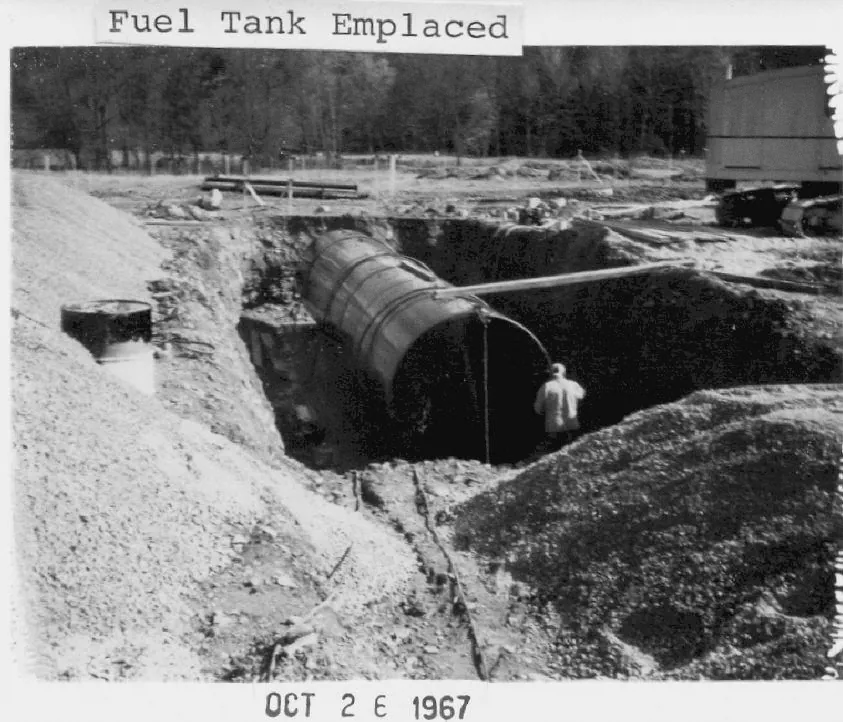
26 Oct 1967“Fuel Tank Emplaced”. 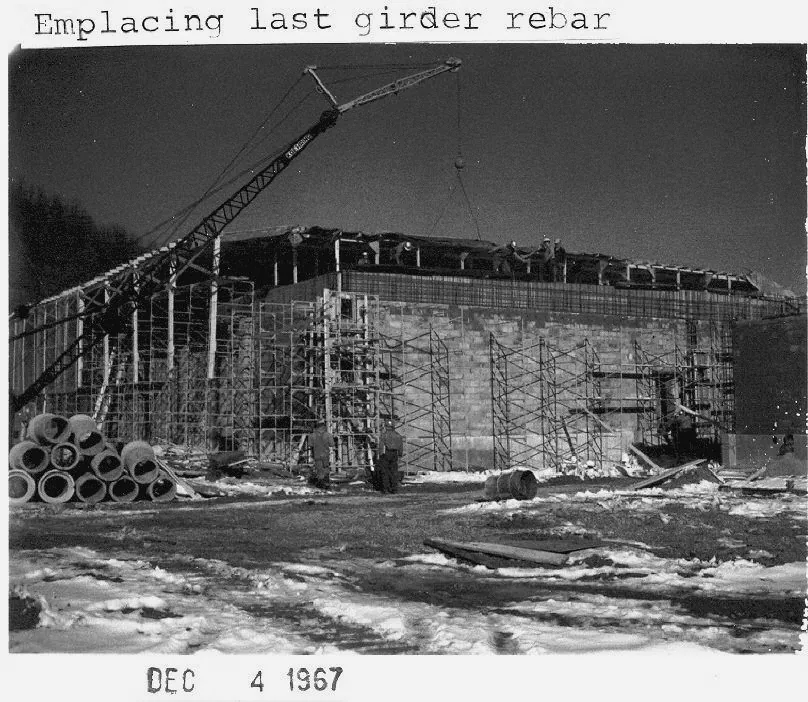
4 Dec 1967“Emplacing last girder rebar”. 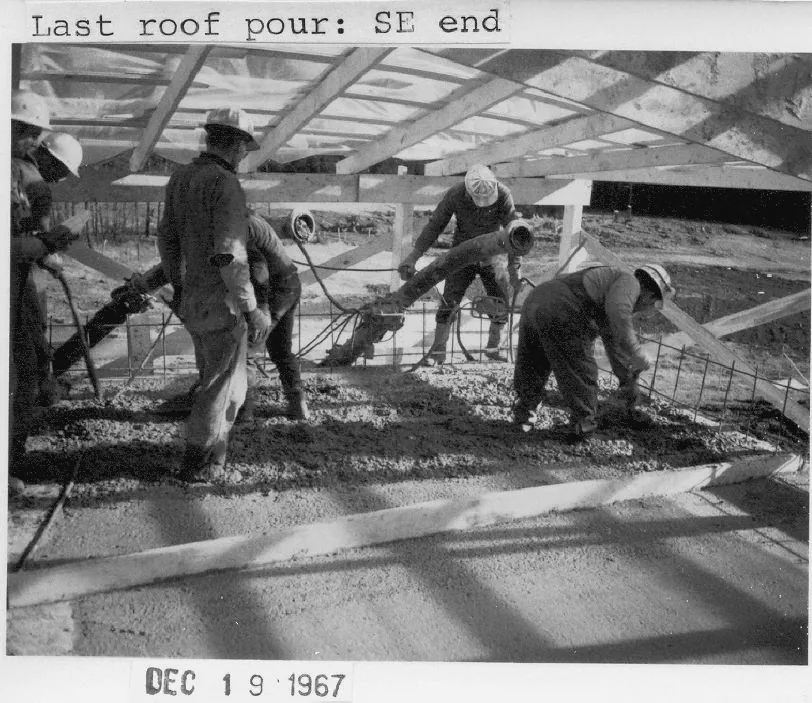
19 Dec 1967“Last roof pour: SE end”. 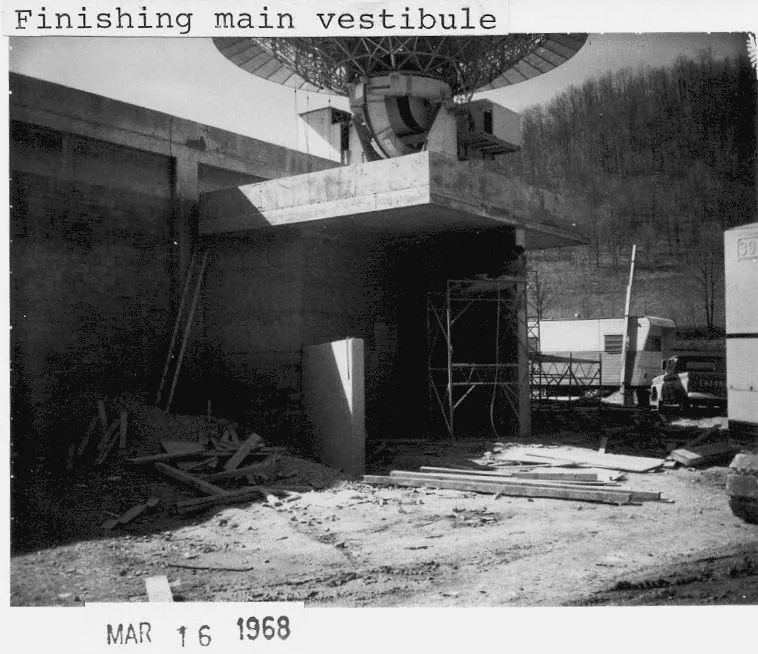
16 Mar 1968The first antenna already stands above the roof. - 196827 September
Dedicated
The station was dedicated on 27 September 1968, with Representative Harley O. Staggers of West Virginia as the speaker. COMSAT managed and operated Etam on behalf of its owners: COMSAT with 50 percent, AT&T with 28.5, RCA Global Communications with 10.5, ITT World Communications with 7 and Western Union International with 4. [3][4][1]
Its first antenna, 97 feet across, dominated the skyline. The station's job was to be the major East Coast facility for communications by satellite: telephone, telegraph, data and television between the US mainland, Puerto Rico, the Caribbean, Europe and Latin America. [3][4]
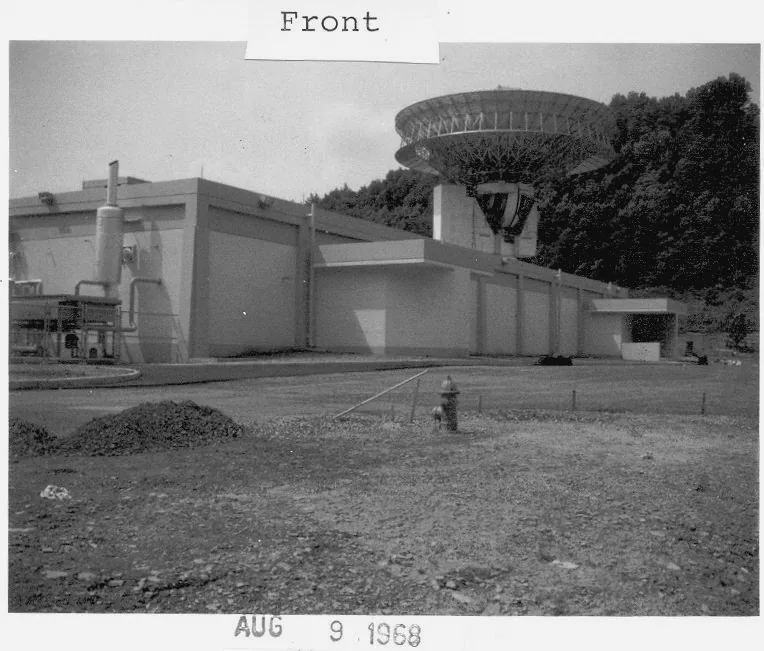
9 Aug 1968The finished building and the 97 ft antenna. 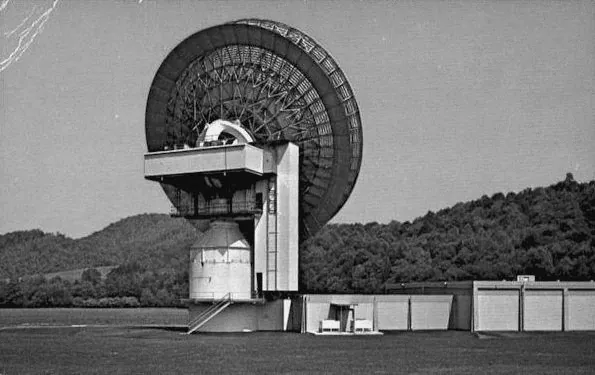
c. 1970The 97 ft antenna on a picture postcard of the time. - 1968October
Apollo 7 and the Mexico City Olympics
In October 1968 NASA's ATS-3 satellite relayed live television of the Apollo 7 recovery at sea; Etam is reported to have received those color pictures. That same month a British technical journal named Etam as a back-up station for relaying the Mexico City Olympics to Europe. [4][5][6]
- 1968–69Into service
The prime East Coast terminal
As INTELSAT III F-2 took over Atlantic traffic, NASA reported that Etam would become the prime East Coast terminal. On 28 December 1968 the new satellite was used between Etam and Raisting, in Germany, under emergency authorization, to back up an interruption on the TAT-4 transatlantic cable. COMSAT records that the station entered service in January 1969. [4][1][2]
On 20 January 1969 the inauguration of President Nixon became the first presidential inauguration shown live in color by satellite in Europe and Latin America, sent through the earth station at Etam and INTELSAT III. [7]
- 1969May
Apollo 10
For Apollo 10, NASA planned to link its Atlantic tracking stations, on Ascension Island, at the Canary Islands and aboard an Atlantic tracking ship, through the Atlantic INTELSAT satellite via the COMSAT-operated ground station at Etam. [8]
- 1970sTest bed
SPADE and SATNET
Etam was a proving ground as well as a gateway. SPADE, a system that assigned satellite telephone channels on demand, was tested between Etam and Goonhilly Downs in Cornwall over INTELSAT III. Later in the decade Etam was the American Standard A station of SATNET, ARPA's experimental packet-satellite network, linking with Goonhilly in Britain and Tanum in Sweden over INTELSAT IV-A: a transatlantic piece of the early internet. [9][10]
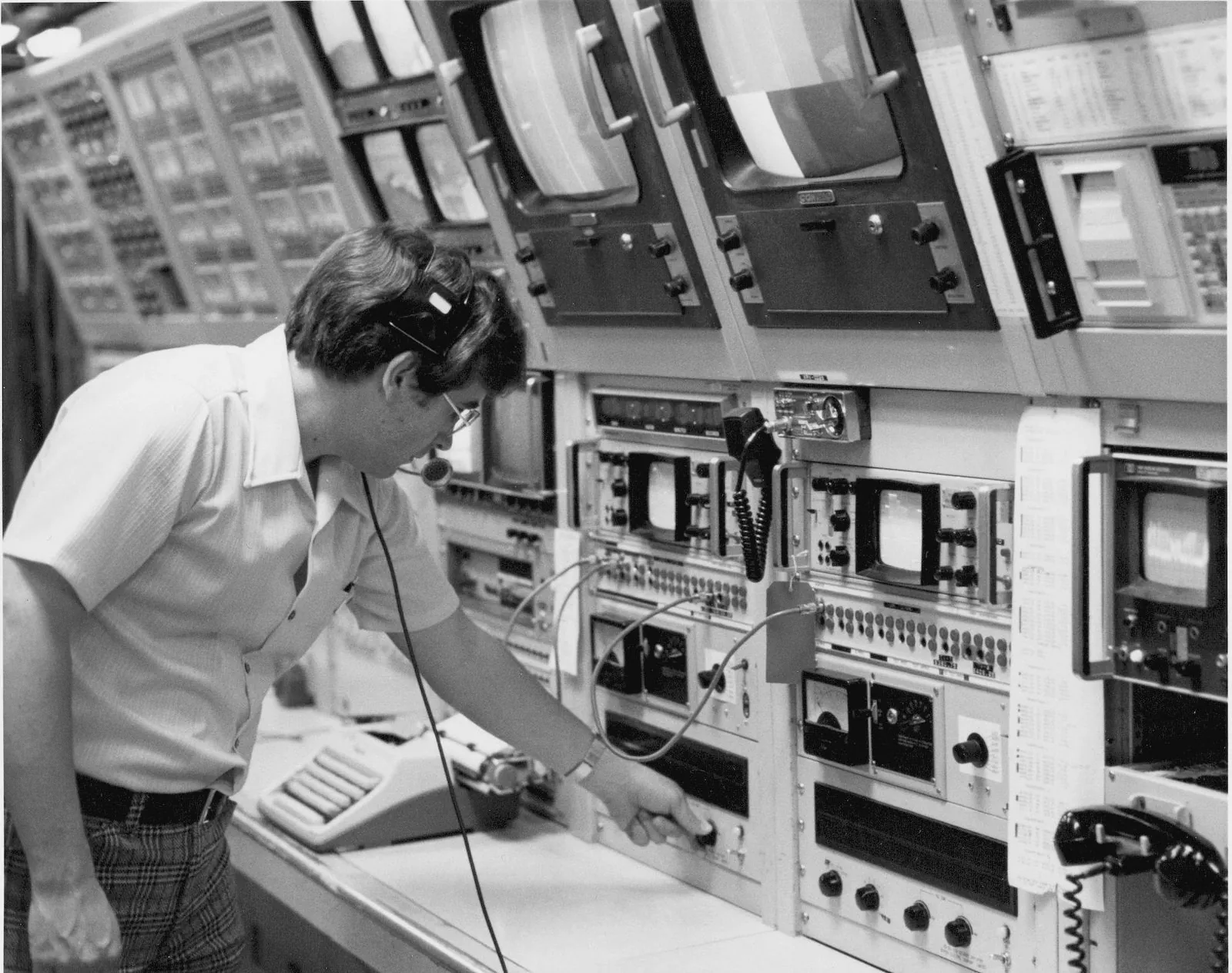
c. 1970sTelevision monitoring racks. - 197424 December
The Hotline
Etam was the US earth station for the satellite circuit of the Washington–Moscow Hotline: a leased duplex circuit from the COMSAT station at Etam, through an INTELSAT satellite, to an earth station near Moscow. COMSAT records the link as activated on 24 December 1974; after years of testing, it is reported to have entered full operation in January 1978. [9][2][11]
- 19752 November
A second, 32-meter antenna
In January 1974 COMSAT and its partners announced plans for two new 32-meter antennas, one at Andover, Maine, and one at Etam. Etam's entered operation on 2 November 1975 and began commercial service in early 1976 with the new INTELSAT IV-A satellites. [12][2]
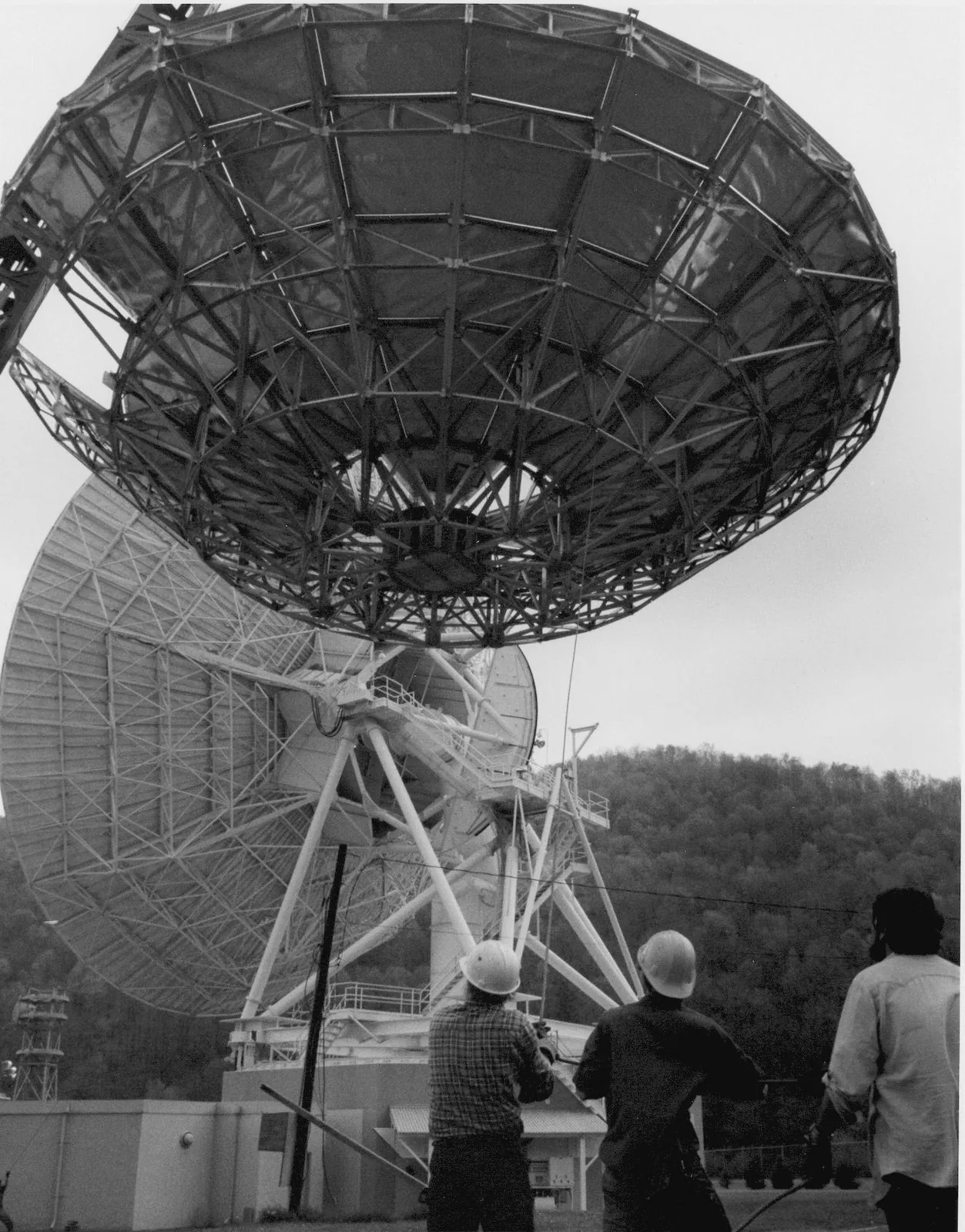
c. 1970sA reflector section lifted into place beside an existing antenna. 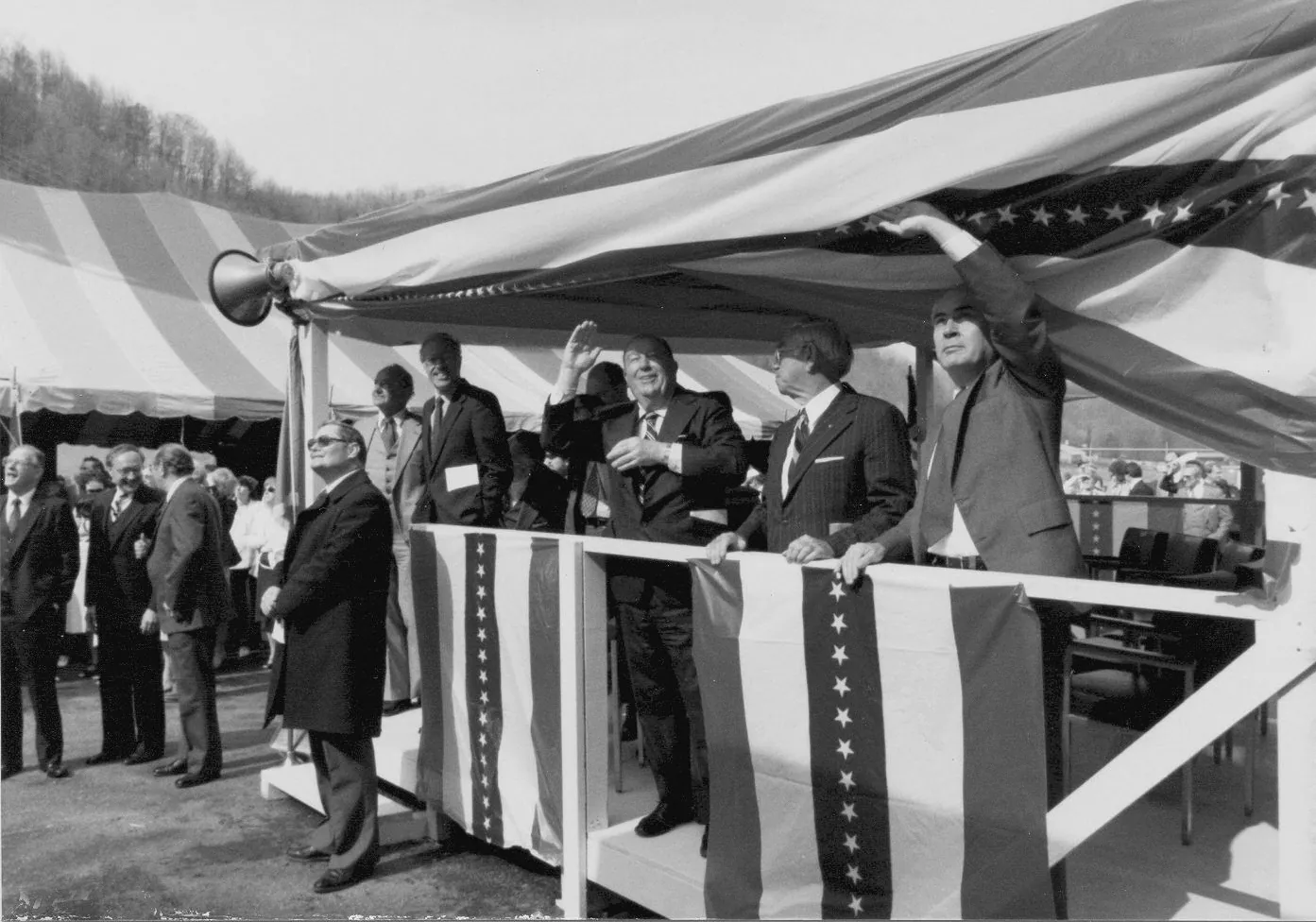
c. 1970sA ceremony at the station. - 1976–77On the air
Newspapers and inaugurations
On 9 December 1976 the front page of The Washington Post was sent by facsimile on a single satellite circuit from Etam to Rome, in about five minutes. In January 1977 Andover, Etam and Jamesburg carried President Carter's inauguration to about 70 countries. [2][13]
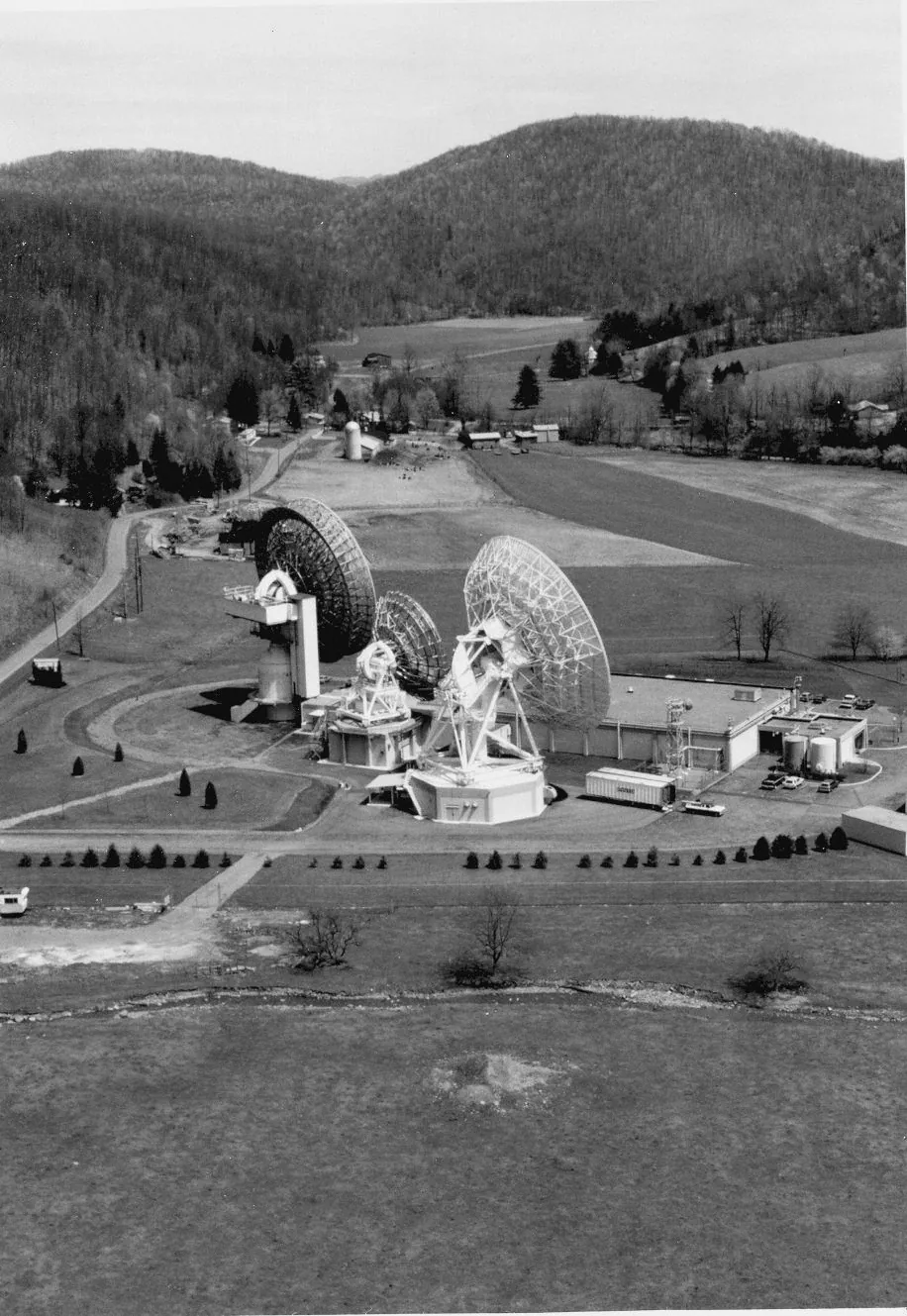
After 1975From the air: the 97 ft antenna on its tall pedestal, a smaller dish, and the 32 m antenna of 1975. 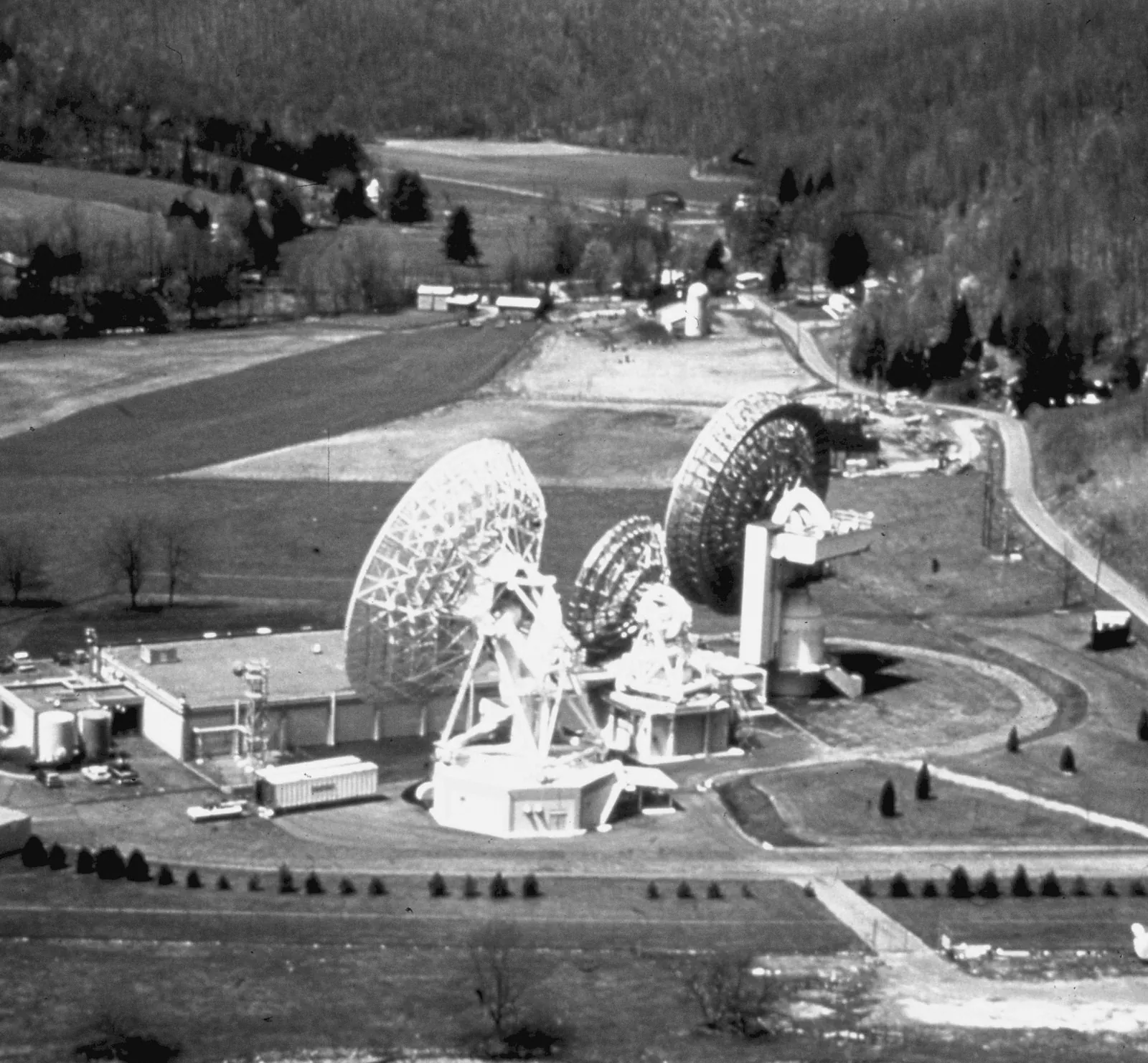
After 1975The station from the air, from a color slide. - 1988AT&T
The AT&T years
In 1985 COMSAT agreed to sell its 50 percent interest in Etam, and in two other earth stations, to AT&T, effective 1 January 1988. AT&T then ran the station. By 2020 AT&T said the site had not been active for years. [14][5]
- 2020December
A new owner
By early 2020 the station was vacant and for sale. It was sold in December 2020; its new owners reportedly planned to bring the antennas back on line. [5][15]
- TodayXCVR
Back on the air
All four antennas are working again, transmitting and receiving. XCVR operates the station for satellite services, research and radio astronomy, and keeps its history in view.
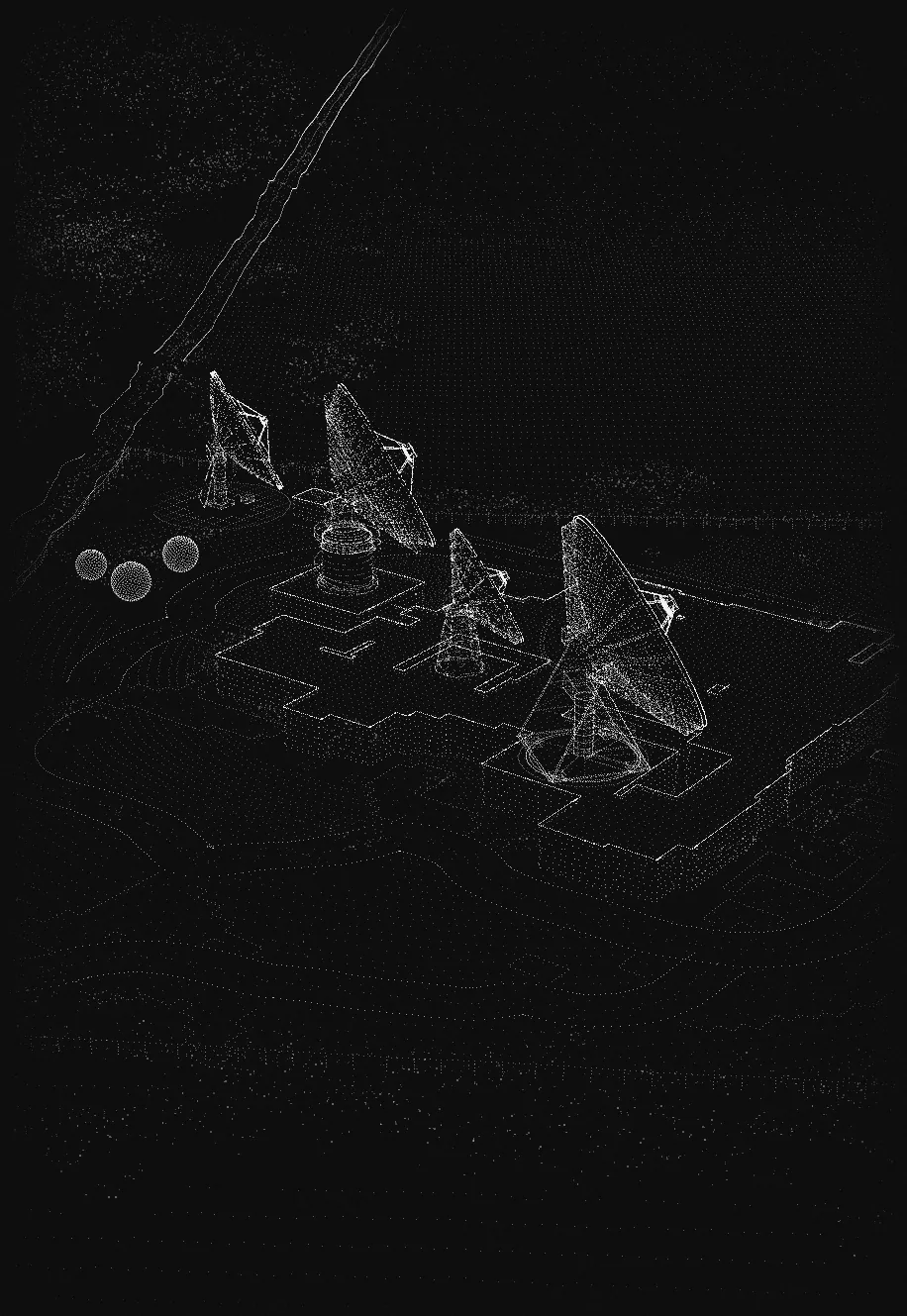
Then and nowThe same view, drawn from the airborne-LiDAR survey of February 2020. Render modelled. 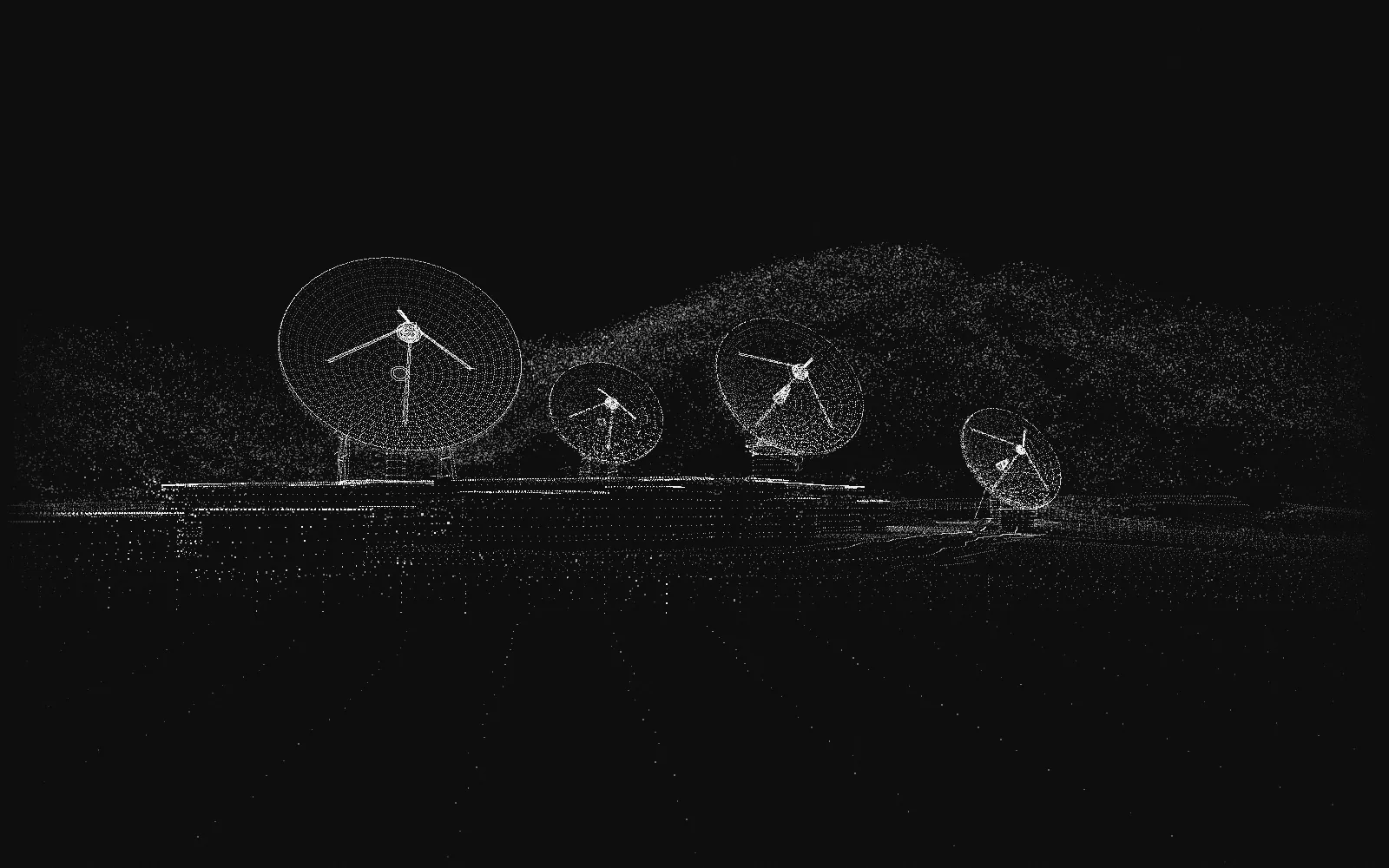
2020 surveyThe four antennas from the field. Render modelled.
Sources
Where this history comes from
Every statement on this page is drawn from the sources listed here. Where only one source names Etam, the text says “is reported to”. Archive photographs are from the station's archive; dates come from the stamps on the prints, or from what they show. Point-cloud views are our own renders of the USGS 3D Elevation Program airborne-LiDAR survey (public domain).
- COMSAT, COMSAT at 10 (chronology, c. 1973), COMSAT Legacy Project. comsat-history.com
- COMSAT, COMSAT at 15 (chronology, c. 1978), COMSAT Legacy Project. comsat-history.com
- RCA Relay (RCA Global Communications), Sep–Oct 1968, “Etam Earth Station”. worldradiohistory.com
- NASA, Astronautics and Aeronautics, 1968 (NASA SP-4010), entries for 27 Sep, Oct, 18 and 28 Dec 1968. nasa.gov
- R. Steelhammer, Charleston Gazette-Mail, “Preston satellite station that played role in history-making events up for sale”, Feb 2020. archive.org
- Wireless World, Nov 1968, p. 401, “Olympic Games via ATS III”. worldradiohistory.com
- Broadcast Engineering, Mar 1969, “Nixon Inaugural Makes Two Firsts In Broadcasting”. worldradiohistory.com
- NASA, Apollo 10 Press Kit, Release 69-68, May 1969, network section. nasa.gov
- NASA Goddard, NASA Compendium of Satellite Communications Programs (1975), NTRS 19760014165. ntrs.nasa.gov
- COMSAT Laboratories, COMSAT Participation in ARPA Packet Satellite Program, final report, 1979, DTIC ADA089224. archive.org
- Electrospaces.net, “The Washington–Moscow Hot Line”. electrospaces.net
- NASA, Astronautics and Aeronautics, 1974, entry for 7 Jan 1974. nasa.gov
- NASA, Astronautics and Aeronautics, 1977. nasa.gov
- Los Angeles Times, “AT&T Pays $55 Million for 50% Interest: Comsat to Sell 3 Big Earth Stations”, 6 Jun 1985. latimes.com
- The Dominion Post (Morgantown), 21 Mar 2021. dominionpost.com